
Introduction
Produced water is an unavoidable byproduct of oil and gas production and often represents the largest waste stream generated by upstream operations. As fields mature, water production typically increases, placing additional demands on treatment facilities, disposal systems, and operating budgets.
Managing produced water effectively requires more than simply adding treatment equipment. Successful projects rely on sound engineering, process optimization, operational understanding, and a systematic evaluation of treatment objectives and facility constraints.
At NEXUS Flow & Readiness Solutions LLC, we support operators in improving produced water management through engineering studies, process reviews, troubleshooting, and operational readiness support.
Effective water treatment is not measured by the equipment installed, but by the engineering decisions that transform operational challenges into reliable performance.
The Growing Challenge of Produced Water
Many facilities were originally designed for lower water production rates. As reservoirs age, operators frequently encounter:
- Increased water cut
- Reduced separator efficiency
- Higher chemical consumption
- Produced water quality excursions
- Disposal and injection constraints
- Increased operating costs
- Process bottlenecks
Without proper engineering evaluation, these issues can reduce production efficiency and increase operational risk.

Engineering-Driven Water Treatment Optimization
A structured engineering approach allows operators to identify root causes and improve system performance without necessarily installing major new equipment.
Typical engineering activities include:
Process Performance Assessment
Evaluation of:
- Separator performance
- Residence time adequacy
- Hydraulic loading
- Equipment operating limits
- Water quality compliance
This provides a clear understanding of current system limitations and opportunities for improvement.
Process Simulation and Hydraulic Review
Engineering simulations can be used to evaluate:
- Flow distribution
- System bottlenecks
- Equipment loading
- Future production scenarios
- Expansion requirements
Process modeling helps operators make informed decisions before implementing modifications.
Chemical Treatment Optimization
Chemical programs often represent a significant operating expense.
Engineering reviews can identify opportunities to improve:
- Demulsifier performance
- Scale inhibition
- Corrosion control
- Solids management
- Chemical injection strategies
The objective is to achieve treatment targets while minimizing chemical consumption.
Common Produced Water Treatment Technologies
Depending on water quality requirements and disposal strategy, treatment systems may include:
Primary Separation
- Three-phase separators
- Free water knockout vessels
- Degassing systems
Secondary Treatment
- Hydrocyclones
- Induced gas flotation units
- Compact flotation systems
Tertiary Treatment
- Media filtration
- Walnut shell filters
- Membrane systems
- Advanced polishing technologies
The optimal treatment train depends on field-specific conditions, water chemistry, and operational requirements.
Produced Water Reuse and Injection Systems
Many operators seek opportunities to reuse produced water for:
- Water injection
- Enhanced recovery projects
- Utility systems
- Industrial applications
These applications require careful assessment of:
- Water quality
- Scaling tendency
- Corrosion risk
- Solids content
- Injection compatibility
Engineering studies help define treatment requirements and operating limits for reliable long-term performance.
Troubleshooting Existing Facilities
Produced water systems frequently experience operational issues such as:
- Excessive oil carryover
- Solids accumulation
- Fouling
- Chemical inefficiency
- Unstable separator performance
- Injection well plugging
A systematic engineering review can identify root causes and provide practical recommendations to improve reliability and performance.
The Importance of Operational Readiness
Even well-designed systems can underperform if operating procedures and readiness plans are not properly established.
Key considerations include:
- Startup procedures
- Shutdown procedures
- Chemical management plans
- Operator training
- Performance monitoring
- Troubleshooting guidance
Integrating operational readiness with engineering design supports smoother facility operation and improved treatment performance.
How NEXUS Supports Produced Water Projects
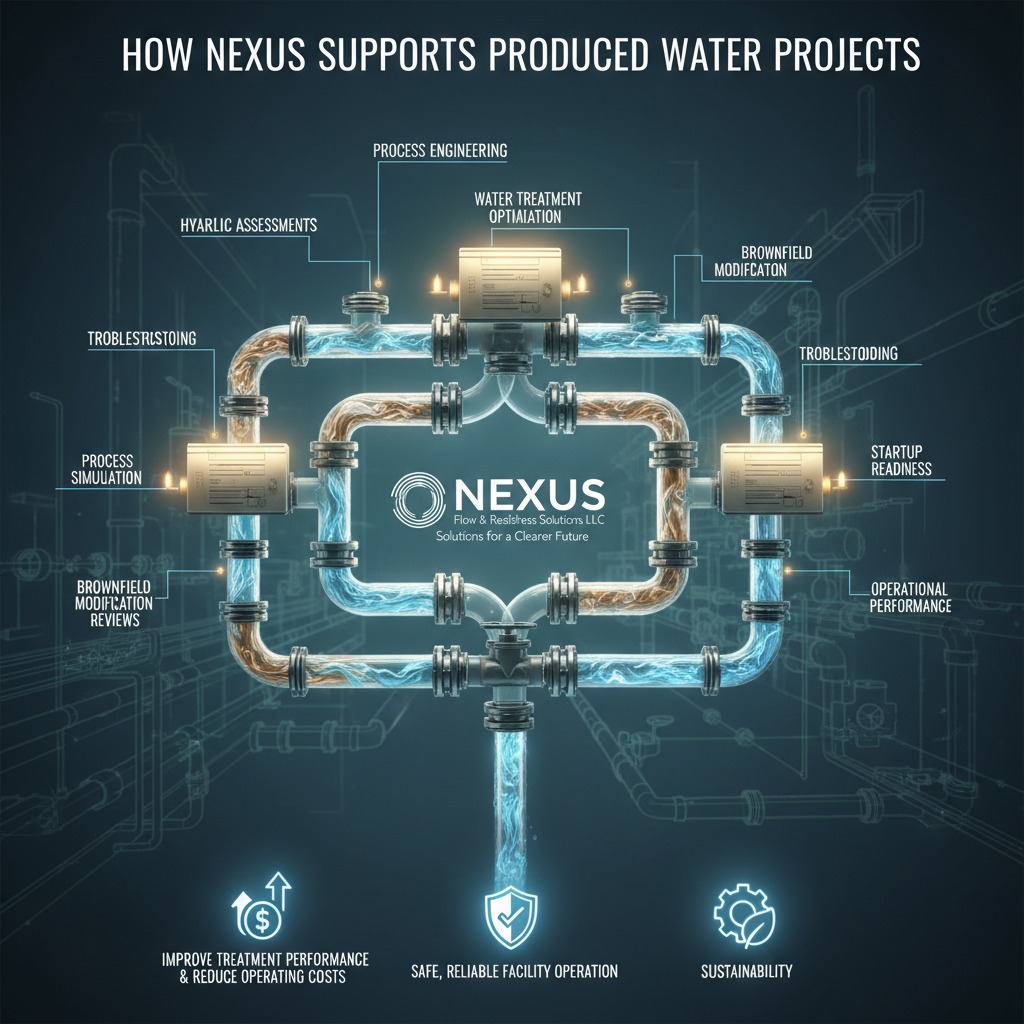
NEXUS Flow & Readiness Solutions LLC provides specialist support for produced water treatment projects through:
- Process engineering studies
- Hydraulic assessments
- Water treatment optimization
- Troubleshooting support
- Process simulation
- Brownfield modification reviews
- Startup readiness assessments
- Operational performance evaluations
Our objective is to help operators improve treatment performance, reduce operating costs, and support safe, reliable facility operation.
How NEXUS Supports Produced Water Projects
NEXUS Flow & Readiness Solutions LLC provides specialist support for produced water treatment projects through:
- Process engineering studies
- Hydraulic assessments
- Water treatment optimization
- Troubleshooting support
- Process simulation
- Brownfield modification reviews
- Startup readiness assessments
- Operational performance evaluations
Our objective is to help operators improve treatment performance, reduce operating costs, and support safe, reliable facility operation.
Leave a Reply